To Kill A Mockingbird Movie Download Yify
| To Kill a Mockingbird | |
|---|---|
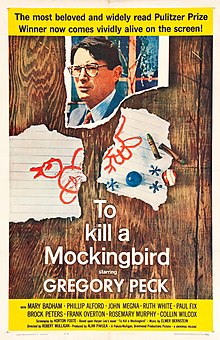 Theatrical release affiche | |
| Directed by | Robert Mulligan |
| Screenplay by | Horton Foote |
| Based on | To Kill a Mockingbird by Harper Lee |
| Produced by | Alan J. Pakula |
| Starring |
|
| Cinematography | Russell Harlan, A.South.C. |
| Edited by | Aaron Stell, A.C.E. |
| Music by | Elmer Bernstein |
| Production |
|
| Distributed by | Universal Pictures |
| Release date |
|
| Running time | 129 minutes[ane] |
| Country | U.s.a. |
| Linguistic communication | English language |
| Budget | $2 million[two] |
| Box function | $13.1 million[2] |
To Kill a Mockingbird is a 1962 American drama moving-picture show directed by Robert Mulligan. The screenplay by Horton Foote is based on Harper Lee's 1960 Pulitzer Prize–winning novel of the same name. The motion picture stars Gregory Peck as Atticus Finch and Mary Badham equally Scout. It marked the film debut of Robert Duvall, William Windom and Alice Ghostley.
It gained overwhelmingly positive reception from both the critics and the public; a box-office success, it earned more than six times its budget. The pic won three Academy Awards, including All-time Role player for Peck, and was nominated for eight, including All-time Motion picture.
In 1995, the picture was selected by the Library of Congress for preservation in the National Flick Registry as "culturally, historically, or aesthetically significant". In 2003, the American Moving-picture show Institute named Atticus Finch the greatest movie hero of the 20th century. In 2007, the film ranked twenty-fifth on the AFI's 10th anniversary list of the greatest American movies of all time. In 2005, the British Film Institute included it in their list of the 50 films you should see by the age of 14. The moving-picture show was restored and released on Blu-ray and DVD in 2012, as part of the 100th ceremony of Universal Pictures.[3] Many consider it one of the best films ever made.
Plot [edit]
The film is narrated by the adult Jean Louise "Picket" Finch. Young Scout and her pre-teen older blood brother Jem live in the fictional boondocks of Maycomb, Alabama, during the early on 1930s. Despite the family's pocket-size means, the children enjoy a happy childhood, cared for past their widowed father, Atticus Finch, and the family's black housekeeper, Calpurnia. During the summer, Jem, Scout, and their friend Dill play games and often search for Arthur "Boo" Radley, an odd, reclusive neighbor who lives with his brother Nathan. The children accept never seen Boo, who rarely leaves the house. On different occasions, Jem has establish small objects left inside a tree knothole on the Radley property. These include a broken pocket watch, an old spelling bee medal, a pocket knife, and two carved soap dolls resembling Jem and Watch.
Atticus, a lawyer, strongly believes all people deserve off-white treatment, in turning the other cheek, and in defending what yous believe. Many of Atticus' clients are poor farmers who pay for his legal services in trade, often leaving him fresh produce, firewood, and and so on.[4] Atticus' piece of work as a lawyer often exposes Scout and Jem to the town'south racism, aggravated by poverty. Every bit a result, the children mature more chop-chop.
Atticus is appointed to defend Tom Robinson, a black homo accused of raping a white girl, Mayella Ewell. Atticus accepts the case, heightening tension in the town and causing Jem and Lookout man to feel schoolyard taunts. 1 evening before the trial, as Atticus sits in front of the local jail to safeguard Robinson, a lynch mob arrives. Picket, Jem, and Dill unexpectedly interrupt the confrontation. Picket, unaware of the mob'south purpose, recognizes Mr. Cunningham and asks him to say how-do-you-do to his son Walter, her classmate. Cunningham becomes embarrassed, and the mob disperses.
At the trial, it is alleged that Tom entered the Ewell holding at Mayella'south request to chop up a chifforobe and that Mayella showed signs of having been beaten around that time. Among Atticus' chief defensive arguments is that Tom's left arm is disabled, yet the supposed rapist would have had to mostly assault Mayella with his left manus before raping her. Atticus noted that Mayella's father, Bob Ewell, is left-handed, implying that he beat Mayella considering he caught her seducing a immature black man (Robinson). Atticus too states that Mayella was never examined past a doctor after the supposed set on. Taking the stand, Tom denies he attacked Mayella but states that she kissed him confronting his will. He testifies that he had previously assisted Mayella with diverse chores at her request because he "felt sorry for her" – words that incite a swift, negative reaction from the prosecutor.
In his closing statement, Atticus asks the all-white male jury to cast aside their prejudices and focus on Tom's obvious innocence. However, Tom is found guilty. Every bit Atticus exits the courtroom, the black spectators in the balcony ascent to show their respect and appreciation.
When Atticus arrives home, Sheriff Tate informs him that Tom was killed during his transfer to prison, plain while attempting to escape. Atticus, accompanied past Jem, goes to the Robinson dwelling to relay news of Tom'south death. Bob Ewell appears and spits in Atticus' face.
Autumn arrives, and Scout and Jem nourish an evening schoolhouse pageant in which Scout portrays a ham. After the pageant, Watch is unable to find her apparel and shoes, forcing her to walk domicile with Jem while wearing the large, hard-shelled costume. While cut through the forest, Picket and Jem are attacked. Scout's cumbersome costume protects her but restricts her vision. The attacker knocks Jem unconscious but is himself attacked (and killed) by a second human being unseen past Scout. Lookout escapes her costume and sees the 2nd homo conveying Jem towards their house. Lookout follows them and runs into the artillery of a frantic Atticus. However unconscious, Jem has his cleaved arm treated by Doc Reynolds.
Scout tells Sheriff Tate and her father what happened, then notices a strange man backside Jem'due south bedroom door. Atticus introduces Scout to Arthur Radley, whom she knows as Boo. Information technology was Boo who rescued Jem and Scout, overpowering Bob Ewell and carrying Jem abode. The sheriff reports that Ewell, apparently seeking revenge for Atticus humiliating him in court, is dead at the scene of the attack. Atticus mistakenly assumes Jem killed Ewell in self-defence, but Sheriff Tate realizes the truth – Boo killed Ewell defending the children. His official study volition land that Ewell died falling on his pocketknife. He refuses to elevate the painfully shy, introverted Boo into the spotlight for his heroism, insisting information technology would be a sin. As Lookout escorts Boo dwelling house, she draws a startlingly precocious illustration: comparison the unwelcome public attention that would accept been heaped on Boo, with the killing of a mockingbird that does nothing only sing.
Cast [edit]
- Gregory Peck as Atticus Finch
- Mary Badham as Sentinel
- Phillip Alford as Jem
- John Megna as Charles Bakery "Dill" Harris
- Frank Overton every bit Sheriff Heck Tate
- Rosemary Irish potato as Miss Maudie Atkinson
- Ruth White as Mrs Dubose
- Brock Peters as Tom Robinson
- Estelle Evans equally Calpurnia
- Paul Fix every bit Guess John Taylor
- Collin Wilcox every bit Mayella Violet Ewell
- James Anderson as Robert E. Lee "Bob" Ewell
- Alice Ghostley equally Miss Stephanie Crawford
- Robert Duvall every bit Arthur "Boo" Radley
- William Windom as Horace Gilmer, Commune Attorney
- Crahan Denton equally Walter Cunningham
- Richard Hale as Nathan Radley
Uncredited roles in order of appearance [edit]
- Kim Stanley as the narrator—the voice of adult Scout—"Maycomb was a tired former town – even in 1932 when I offset knew it – that summertime I was half-dozen years quondam."
- Paulene Myers equally Jessie, Mrs. Dubose's servant, sitting close to her on the Dubose porch.
- Jamie Forster equally Mr. Townsend, sitting on a demote, with 3 men, most the courthouse: "If you're lookin' for your daddy, he'southward inside the courthouse."
- Steve Condit as Walter, Mr. Cunningham's son, at dinner with the Finch family: "Yep, sir. I don't know when I had roast. We been havin' squirrels and rabbits lately."
- David Crawford as David, Tom Robinson'southward son, sitting on the steps to the Robinsons' shack: "Good evening."
- Kim Hamilton equally Helen, Tom Robinson's wife, inside the Robinsons' shack: "Good evening, Mr. Finch."
- Dan White as the mob leader approaching as Atticus Finch sits in front of the jailhouse: "He in at that place, Mr. Finch?"
- Kelly Thordsen every bit a heavyset member of the mob who grabs and picks upwardly Jem: "Well, I'll transport y'all home."
- William "Neb" Walker as Reverend Sykes, at the courthouse for Tom Robinson's trial: "Miss Jean Louise? Miss Jean Louise, stand. Your father's passin'."
- Charles Fredericks as the court clerk at Tom Robinson's trial: "Identify your hand on the bible, please. Do you solemnly swear to tell the truth...?"
- Guy Wilkerson as the jury foreman at Tom Robinson's trial: "We find the defendant guilty as charged."
- Jay Sullivan every bit the court reporter at Tom Robinson'due south trial: "Yep."
- Jester Hairston as Spence, Tom Robinson's father in front of the Robinsons' shack: "Hello Mr. Finch. I'm Spence, Tom'south male parent."
- Hugh Sanders as Md Reynolds, the town physician who examines Jem: "He'southward got a bad break, so far as I can tell. Somebody tried to wring his arm off."
Casting [edit]
James Stewart declined the function of Atticus Finch, concerned that the story was too controversial.[5] Universal offered the role to Rock Hudson when the project was existence showtime developed merely producer Alan J. Pakula wanted a bigger star.[six]
Production [edit]

The Old Monroe Canton Courthouse was the model for the set used in the film

A scene from the play performed in the actual courthouse in Monroeville
The producers had wanted to apply Harper Lee's hometown of Monroeville, Alabama for the set. Harper Lee used her experiences as a child in Monroeville equally the ground for the fictional boondocks of Maycomb, and so it seemed that would be the best identify. However, the boondocks had changed significantly between the 1920s and the early 1960s so they made the backlot in Hollywood instead.[7]
The Old Monroe County Courthouse in Monroeville was used as a model for the film set since they could not use the courthouse due to the poor sound quality in the courthouse. The accuracy of the recreated courthouse in Hollywood led many Alabamians to believe that the moving picture was shot in Monroeville. The Old Courthouse in Monroe County is now a theater for many plays inspired by To Impale a Mockingbird also as a museum dedicated to multiple authors from Monroeville.[viii] [9] [10]
Critical response [edit]
The movie received widespread critical acclaim. Every bit of November 2021, it maintains a 93% rating on Rotten Tomatoes, based on 67 reviews, with an average rating of eight.ninety/x. The site's critical consensus states, "To Kill a Mockingbird is a textbook example of a message movie done right – sober-minded and earnest, only never letting its social conscience go in the way of gripping drama."[xi] According to Bosley Crowther:[12]
Horton Foote's script and the direction of Mr. Mulligan may non penetrate that deeply, simply they do permit Mr. Peck and little Miss Badham and Master Alford to portray delightful characters. Their mannerly enactments of a father and his children in that close relationship, which tin occur at only one brief menses, are worth all the footage of the film. Rosemary Murphy as a neighbor, Brock Peters equally the Negro on trial, and Frank Overton as a troubled sheriff are good every bit locality characters, too. James Anderson and Collin Wilcox as Southern bigots are nigh caricatures. But those are modest shortcomings in a rewarding picture.
Roger Ebert of the Chicago Sun-Times criticized the film for focusing less on the blacks, denouncing the cliché of the honest, white man continuing for a helpless black:[13]
It expresses the liberal pieties of a more than innocent fourth dimension, the early 1960s, and it goes very easy on the realities of pocket-sized-town Alabama in the 1930s. One of the nigh dramatic scenes shows a lynch mob facing Atticus, who is all past himself on the jailhouse steps the nighttime earlier Tom Robinson'southward trial. The mob is armed and prepared to intermission in and hang Robinson, but Sentry bursts onto the scene, recognizes a poor farmer who has been befriended by her begetter, and shames him (and all the other men) into leaving. Her speech is a calculated strategic exercise, masked as the innocent words of a child; 1 shot of her eyes shows she realizes exactly what she's doing. Could a child turn away a lynch mob at that time, in that place? Isn't it nice to think so.
Walt Disney requested that the film exist privately screened in his house. At the film's determination, Disney sadly stated, "That was i hell of a pic. That'southward the kind of picture show I wish I could make."[14] [15]
In a retrospective review, American movie critic Pauline Kael claimed that, when Gregory Peck received the University Award for Best Actor:[sixteen]
... at that place was a fair corporeality of derision throughout the country: Peck was amend than usual, but in that aforementioned virtuously dull way. (There was the suspicion that Peck was being rewarded because the Lincolnesque lawyer shot a rabid dog and defended an innocent black man accused of raping a white woman.)
Peck'southward performance became synonymous with the part and graphic symbol of Atticus Finch. Producer Alan J. Pakula remembered hearing from Peck when he was showtime approached with the role: "He called back immediately. No maybes. […] I must say the man and the character he played were not unalike".[17] Peck later on said in an interview that he was drawn to the role considering the book reminded him of growing upwardly in La Jolla, California.[18] "Inappreciably a day passes that I don't retrieve how lucky I was to be cast in that film", Peck said in a 1997 interview. "I recently sabbatum at a dinner next to a woman who saw it when she was xiv-years-old, and she said it changed her life. I hear things like that all the time".[xix] The 1962 softcover edition of the novel opens:
- "The Southern boondocks of Maycomb, Alabama, reminds me of the California boondocks I grew upward in. The characters of the novel are like people I knew equally a male child. I retrieve perhaps the dandy appeal of the novel is that it reminds readers everywhere of a person or a town they take known. It is to me a universal story – moving, passionate and told with great humor and tenderness." Gregory Peck.
Harper Lee, in liner notes written for the motion-picture show's DVD re-release by Universal, wrote:
- "When I learned that Gregory Peck would play Atticus Finch in the film production of To Impale a Mockingbird, I was of grade delighted: here was a fine role player who had made great films – what more than could a writer inquire for? ...The years told me his hugger-mugger. When he played Atticus Finch, he had played himself, and fourth dimension has told all of united states of america something more than: when he played himself, he touched the world".[twenty]
Upon Peck's death in 2003, Brock Peters, who played Tom Robinson in the film version, quoted Harper Lee at Peck's eulogy, maxim, "Atticus Finch gave him an opportunity to play himself". Peters concluded his eulogy stating, "To my friend Gregory Peck, to my friend Atticus Finch, vaya con Dios".[21] Peters remembered the role of Tom Robinson when he recalled, "It certainly is one of my proudest achievements in life, one of the happiest participations in moving-picture show or theater I take experienced".[22] Peters remained friends not only with Peck only with Mary Badham throughout his life.
Peck himself admitted that many people reminded him of this film more than any other pic he had ever done.[23]
Awards and honors [edit]
In 1995, To Impale a Mockingbird was selected for preservation in the The states National Film Registry by the Library of Congress as existence "culturally, historically, or aesthetically significant".[35] Information technology is also Robert Duvall'due south large-screen debut, as the misunderstood recluse Boo Radley. Duvall was cast on the recommendation of screenwriter Horton Foote, who met him at Neighborhood Playhouse in New York City where Duvall starred in a 1957 production of Foote'due south play, The Midnight Caller.[36]
In 2007, Hamilton was honored past the Harlem community for her role in the motion-picture show. She was the terminal surviving African-American adult who had a speaking function in the moving picture. When told of the honor, she said, "I think information technology is terrific. I'm very pleased and very surprised".[37]
The American Film Institute named Atticus Finch the greatest movie hero of the 20th century.[38] Additionally, the AFI ranked the movie second on their 100 Years... 100 Cheers list, behind It'due south a Wonderful Life.[39] The movie was ranked number 34 on AFI'due south list of the 100 greatest movies of all fourth dimension, but moved up to number 25 on the 10th Ceremony listing.[forty] In June 2008, the AFI revealed its "10 acme Ten"—the best ten films in ten "classic" American movie genres—after polling over 1,500 people from the creative community. To Kill a Mockingbird was acknowledged as the all-time film in the courtroom drama genre.[41]
American Moving-picture show Plant lists:
- AFI's 100 Years...100 Movies – #34
- AFI'south 100 Years...100 Heroes & Villains:
- Atticus Finch – #1 Hero
- AFI's 100 Years...100 Movie Quotes:
- "Miss Jean Louise, stand up. Your father's passing." – Nominated[42]
- "You never really understand a person until you consider things from his bespeak of view, until y'all climb inside of his pare and walk effectually in it." – Nominated[42]
- AFI's 100 Years of Film Scores – #17
- AFI'south 100 Years...100 Thank you – #2
- AFI's 100 Years...100 Movies: 10th Anniversary Edition– #25
- AFI's ten Acme 10 – #1 Court Drama
Music [edit]
| To Impale a Mockingbird | |
|---|---|
 | |
| Soundtrack album by Elmer Bernstein | |
| Released | Early April 1963[43] |
| Recorded | August 1–two, 1996, City Halls, Glasgow |
| Label | Varèse Sarabande |
Elmer Bernstein's score for To Kill a Mockingbird is regarded as one of the greatest film scores[44] and has been recorded 3 times. Information technology was first released in April 1963 on Ava; then Bernstein re-recorded it in the 1970s for his Film Music Collection series; and finally, he recorded the complete score (below) in 1996 with the Royal Scottish National Orchestra for the Varese Sarabande Motion-picture show Classics serial.
- "Main Title" – iii:21
- "Remember Mama" – 1:08
- "Atticus Accepts The Case – Gyre in the Tire" – ii:06
- "Creepy Caper – Peek-A-Boo" – four:10
- "Ewell'south Hatred" – iii:33
- "Jem's Discovery" – three:47
- "Tree Treasure" – iv:23
- "Lynch Mob" – 3:04
- "Guilty Verdict" – 3:10
- "Ewell Regret It" – 2:11
- "Footsteps in the Dark" – 2:07
- "Assault in the Shadows" – two:28
- "Boo Who" – 3:00
- "Cease Title" – iii:25
Encounter also [edit]
- List of American films of 1962
- La Joven (The Young Ane), the 1960 film
- Trial moving picture
- White savior narrative in film
References [edit]
- ^ "TO Kill A MOCKINGBIRD (A)". British Board of Movie Classification. Dec twenty, 1960. Archived from the original on December 26, 2015. Retrieved Dec 25, 2015.
- ^ a b "To Impale A Mockingbird – Box Role Data, DVD and Blu-ray Sales, Flick News, Cast and Crew Information". The Numbers. Archived from the original on March 2, 2021. Retrieved December 13, 2014.
- ^ Appelo, Tim (January x, 2012). "Universal Celebrates 100th Birthday With New Logo and 13 Film Restorations". The Hollywood Reporter. Archived from the original on November 2, 2012. Retrieved December 10, 2012.
- ^ Harper Lee. "To Kill a Mockingbird: Chapters 2–three". SparkNotes. Archived from the original on July 29, 2013. Retrieved March 17, 2014.
- ^ Eliot, Marc (October 10, 2006). Jimmy Stewart: A Biography. ISBN9780307352682.
- ^ "13 Judicious Facts Nigh to Kill a Mockingbird". October 24, 2015.
- ^ W. Warner Floyd (March 29, 1973). "National Register of Historic Places Registration: Old Monroe County Courthouse". National Park Service. Retrieved August 4, 2018. See also: "Accompanying photos".
- ^ "To Kill a Mockingbird 1962". Movie Locations. Archived from the original on August iv, 2018. Retrieved Baronial four, 2018.
- ^ ""To Kill a Mockingbird" A 50th Ceremony Restoration of the Archetype Picture". Southern Literary Trail. Archived from the original on July five, 2018. Retrieved Baronial 4, 2018.
- ^ "To Kill a Mockingbird". Filming Locations. Archived from the original on August 4, 2018. Retrieved August 4, 2018.
- ^ "To Kill A Mockingbird". www.rottentomatoes.com. Dec 25, 1962. Archived from the original on Oct 30, 2015. Retrieved May 22, 2021.
- ^ Crowther, Bosley (February fifteen, 1963). "1 Adult Omission in a Fine Film: two Superb Discoveries Add to Please". The New York Times. Archived from the original on May 7, 2021. Retrieved June xiii, 2013.
- ^ Ebert, Roger. "To Kill a Mockingbird". Archived from the original on July 8, 2014. Retrieved July 13, 2014.
- ^ Gabler, Neal (2006). Walt Disney: The Triumph of American Imagination. New York: Alfred A. Knopf. p. 587.
- ^ Colt, Sarah (2015). "Walt Disney". The American Experience. Public Broadcasting Service.
- ^ Kael, Pauline (1991). 5001 Nights at the Movies. New York, N.Y.: Picador. p. 776. ISBN978-0-8050-1367-2 . Retrieved July 12, 2021.
- ^ Nichols, Peter (February 27, 1998). "Time Tin can't Kill 'Mockingbird'; [Review]". The New York Times. p. East.1.
- ^ King, Susan (December 22, 1997). "How the Finch Stole Christmas; Q & A WITH GREGORY PECK". Los Angeles Times. p. i.
- ^ Bobbin, Jay (December 21, 1997). "Gregory Peck is Atticus Finch in Harper Lee's To Impale a Mockingbird.". Birmingham News. Birmingham, Alabama. p. 1F.
- ^ Universal Pictures Legacy Series DVD 2005
- ^ Hoffman, Allison; Rubin, H. (June 17, 2003). "Peck Memorial Honors Beloved Actor and Man; The longtime star is remembered for his integrity and constancy". Los Angeles Times. p. B.1.
- ^ Oliver, Myrna (August 24, 2005). "Obituaries; Brock Peters, 78; Stage, Screen, Tv Actor Noted for Role in 'To Kill a Mockingbird'". Los Angeles Times. p. B.eight.
- ^ Gregory Peck Interview with Jimmy Carter Archived November 28, 2015, at the Wayback Machine at YouTube
- ^ "NY Times: To Impale a Mockingbird". Movies & TV Dept. The New York Times. 2012. Archived from the original on November iv, 2012. Retrieved December 24, 2008.
- ^ "The 35th Academy Awards (1963) Nominees and Winners". oscars.org. Archived from the original on February two, 2018. Retrieved Baronial 23, 2011.
- ^ "BAFTA Awards: Motion-picture show in 1964". BAFTA. 1964. Retrieved September xvi, 2016.
- ^ "Festival de Cannes: To Impale a Mockingbird". festival-cannes.com. Archived from the original on October 18, 2012. Retrieved February 27, 2009.
- ^ "1963 Cannes Film Festival". Internet Movie Database. Archived from the original on May seven, 2021. Retrieved October 2, 2012.
- ^ "15th DGA Awards". Directors Guild of America Awards . Retrieved July 5, 2021.
- ^ "To Kill a Mockingbird – Golden Globes". HFPA . Retrieved July five, 2021.
- ^ Weiler, A. H. (December 31, 1963). "Flick Critics Vote 'Tom Jones' Best of Year; Finney Named Top Role player for Title Role --'Hud' Honored Finney in 3d Film". The New York Times. Archived from the original on August 19, 2020. Retrieved December 29, 2017.
- ^ "Moving-picture show Hall of Fame Productions". Online Film & Television Association . Retrieved May 15, 2021.
- ^ Madigan, Nick (March 3, 1999). "Producers tap 'Ryan'; Kelly, Hanks Television receiver winners". Variety. Archived from the original on September 23, 2017. Retrieved September 22, 2017.
- ^ "Awards Winners". Writers Guild of America. Archived from the original on December v, 2012. Retrieved June 6, 2010.
- ^ "To Kill a Mockingbird – Awards – IMDb". Archived from the original on March 27, 2018. Retrieved June 29, 2018.
- ^ Robert Duvall (thespian), Gary Hertz (managing director) (April 16, 2002). Miracles & Mercies (Documentary). West Hollywood, California: Blueish Underground. Retrieved January 28, 2008.
- ^ "Harlem community honors 'Mockingbird' actress" Archived July eight, 2010, at the Wayback Machine. USA Today.
- ^ "Archived re-create" (PDF). Archived (PDF) from the original on May 20, 2012. Retrieved April 23, 2010.
{{cite web}}: CS1 maint: archived copy as championship (link) - ^ "AFI'Due south 100 Years... 100 Thank you" (PDF). Archived from the original (PDF) on November 22, 2009. Retrieved June 12, 2010.
- ^ "Archived copy" (PDF). Archived (PDF) from the original on July 21, 2011. Retrieved April 23, 2010.
{{cite web}}: CS1 maint: archived copy every bit title (link) - ^ "AFI's 10 Top 10". American Pic Found. June 17, 2008. Archived from the original on June xix, 2008. Retrieved June xviii, 2008.
- ^ a b "AFI's 100 Years...100 Picture Quotes Nominees" (PDF). Archived (PDF) from the original on June 24, 2016. Retrieved June 13, 2013.
- ^ "Anthology Reviews" Archived Baronial 19, 2020, at the Wayback Machine, Billboard April 13, 1963.
- ^ Erikson, Matthew. "Elmer Bernstein: 'I of the Greatest Film Composers Ever'". Hartford Courant. Archived from the original on April 16, 2018. Retrieved September 24, 2016.
External links [edit]

- To Kill a Mockingbird at IMDb
- To Kill a Mockingbird at the TCM Moving-picture show Database
- To Kill a Mockingbird at Box Office Mojo
- To Kill a Mockingbird at Rotten Tomatoes
- To Kill a Mockingbird at the American Film Plant Itemize
- To Kill A Mockingbird location and production notes
DOWNLOAD HERE
Posted by: curtisprectephe.blogspot.com